The storm has passed, the yard is a mess, and the most dangerous hours in tree work are starting. In Waxhaw, the two days after a major thunderstorm or ice event are when split trunks shift, hanging limbs finally let go, and well-meaning homeowners climb ladders with saws they would never use on a calm Saturday. Storm work is statistically the most dangerous kind of tree work, and the first 48 hours are about triage: what can hurt someone, what can wait, and what should not be touched at all until a crew with the right equipment arrives.
Start from symptoms, as with any troubleshooting problem. Each thing you see in the yard maps to a likely cause and a safe next move, and the order matters more than speed. A yard made safe slowly beats a yard made worse quickly.
Reading the damage: symptom to cause
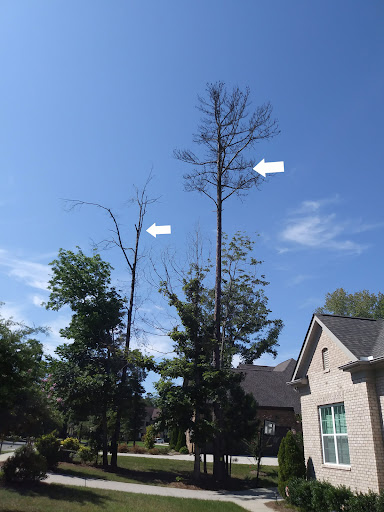
The limb hanging by a strip of bark over the driveway, the classic hanger, is under stored tension and can drop or swing without warning; its cause is a partial break, and its safe treatment is to keep people out from under it until it is taken down by someone working from a position that is not beneath it. The trunk split down the middle between two leaders means the union failed under wind load; a split that is still held together may be a candidate for prompt professional evaluation, since trees under tension behave unpredictably when cut. Uprooting, where the root plate has lifted and soil has cracked on the opposite side, signals a tree in the act of falling, even if it currently leans against a neighbor tree; that is a no-approach zone.
- Keep people and pets out of the fall zones. Treat every hanging limb and leaning tree as loaded. Mark the area off and route foot traffic around it.
- Check for lines before anything else. Any tree or limb touching a power line stays untouched, full stop, until the utility has dealt with the line.
- Photograph everything before cleanup. Wide shots and close-ups of each damaged tree document the condition for the crew and for any claim you file.
- Clear only the safe, ground-level debris. Fallen branches that are fully on the ground, not under tension, can be moved by hand or cut with care.
- Do not cut spring-loaded limbs. Bent, trapped, or partially attached wood stores energy and kicks when cut; identifying it is easy, releasing it safely is the professional part.
- Call for assessment within the first day. Hangers, splits, and uprooted trees get professional eyes quickly, because their condition degrades as wood dries and shifts.
- Plan the rest after triage. Cosmetic cleanup, stump decisions, and replanting all belong after the hazards are down, not competing with them for the crew's first visit.
Why storm work is the dangerous kind
Calm-day tree work is planned: the crew chooses cut order, drop zones, and rigging with a stable tree. Storm work inverts that. Wood is under loads from directions it never grew for, breaks are partial and hidden, and every cut changes the forces on the piece next to it. Add saturated Piedmont soil that lets root plates keep moving, fences and roofs complicating every drop, and the pressure of a blocked driveway, and the risk picture is complete. This is why the honest homeowner scope in the first 48 hours is perimeter safety, documentation, and debris that is fully down and slack.
After the hazards are down
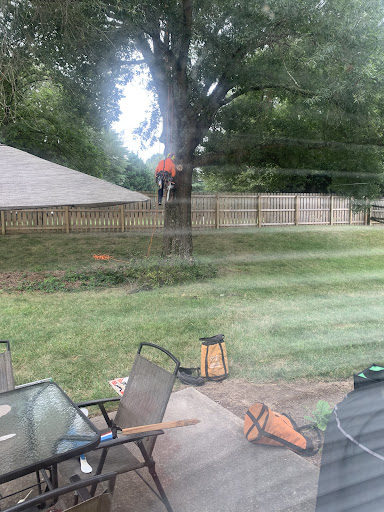
Once a crew, Rhodes Tree Service LLC among the Waxhaw services that handle storm damage cleanup, has cleared the dangerous work, the second phase is ordinary again: decide which damaged trees recover with corrective pruning, which come out, and what the stumps get. Resist deciding all of it curbside in the first hour. Trees that lost a major leader may still be worth keeping with structured pruning over a couple of seasons, and trees that look merely shabby sometimes carry a split that settles the question the other way. The 48-hour rule governs safety, not final verdicts.
Common questions
A limb is hanging over my driveway. Can I pull it down with a truck and rope?
No. Hangers are under unpredictable tension and can swing, roll, or drop on the pull. Keep the area clear and let a crew take it down with rigging from a safe position.
Part of my tree is on a power line. What do I do?
Stay away from the tree entirely and contact the utility. Lines can be energized even when they look still, and tree work near them is restricted to qualified line-clearance crews.
Should I cut the broken branches off flush right away to help the tree?
Broken stubs should eventually be pruned back correctly to the collar, but not at the cost of climbing into a damaged tree during the hazardous window. Safety triage first, corrective pruning on the follow-up visit.
← All guides from Rhodes Tree Service LLC← Back to Rhodes Tree Service LLC